NHacker Next
- new
- past
- show
- ask
- show
- jobs
- submit
login
Rendered at 22:25:06 GMT+0000 (Coordinated Universal Time) with Vercel.
I would love to play something like that again on my phone.
https://en.wikipedia.org/wiki/Space_Trader_(Palm_OS)
I played it recently on iOS via the palm web emulator
Gonna be pedantic/crotchety about this because I got into advanced math classes but it was my brother who got the 84+ (I had to settle for a 83+). Guess who's the engineer now, and who's the NEET? Your kids pay attention to what (who) you value, folks.
And it sure would be funny if the calculator was a one-off instead of just one instance in a pattern of dysfunctional parenting that taught:
Son 1: The family will always have your back, no matter the outcome as; you'll be rewarded, so long as you try.
Son 2: No matter what you accomplish, you will be valued less.
Real laugh-riot there. Hope that clears things up.
I had a TI-85 (maybe 86), unlike the entire rest of my school who had 83s.
There was a difference: when programming in TI-Basic, variable names on a TI-83 are limited to a single character. On the 85, you can make them longer.
But that was pretty much the only difference, and it will never come up if you're using the calculator for school-related reasons.
(For calculus, I had an 89. The differences are much more significant there.)
I also was the one person with a TI-85 in a school of 83s. But by the time I took the statistics class I knew enough BASIC to write my own programs to replicate the functionality that was missing.
Reason : making due with more scarcity increased independence and critical thinking.
I don't know if that was your point...
No, I was too scared to ask.
But yeah, Casio was definitely more friendly and polished in UI, but dumber. You could only use "wizard" type things and pseudo gui clickies while the ti was crude and text-heavy but let you enter just about anything anywhere and seemed more symbol and language oriented. Which one was nicer in use? I guess it would depend on how much of that language you could memorize. Or browse a cheat sheet for.
Best gift ever. I could finish all numeric methods tests in a fraction of the time it took for others to use or program the ordinary calculators. It was a huge qualitative leap.
Somewhat related. My mom once yelled at me for losing a necklace she really liked. Then we were moving her stuff out of her house and found the necklace behind a wardrobe, wedged between it and the wall. It had been there for like 40 years, layered in dust.
When Luther's house in Wittenberg was excavated about 20 years ago, a golden ring[2] was found that must have been deposited there before 1540. It is therefore quite likely that this is the ring mentioned by Luther in 1537.
[1] See WA, BR 8: no 3162 -- https://archive.org/details/werkebriefwechse08luthuoft/page/...
[2] Here is an image of the ring: https://www.zum.de/Faecher/G/BW/Landeskunde/rhein/geschichte...
My Catherine thanks you for the golden ring, whom I have hardly ever seen more indignant than when she realized that it had been stolen or lost through her own negligence (which is not likely for me, although I still insist on it), which I had persuaded her that this gift was a happy omen and augury sent to her, as if it were now certain that your Church would agree pleasantly with ours; this grieves the woman wonderfully.
edit: Not code, just convention.
The more practical reason to mount ground down is that wall warts with ground pins or polarized prongs nearly universally arrange them so that they're hanging down when inserted into a ground-down plug. If the plug's flipped, the wall wart's upside down and its weight is trying to lever it out of the wall.
TBH, in the house I mount them ground down, but under cabinets or in the garage/shop or etc I mount it ground up.
> 3x Processing Power - Matching one of the speculated options, the calculator appears to use an ARM Cortex CPU, finally retiring the z80 and ez80 family of CPUs that were used in three decades of TI-83 and TI-84 Plus graphing calculators. It's running at 156MHz, compared to the 48MHz of the older calculators. It appears likely that in an unexpected break from over 30 years of TI's operating system codebase, the OS has been re-implemented with new features natively on the ARM CPU rather than using an ez80 emulator to run an updated form of the TI-84 Plus CE operating system.
It looks like TI is finally moving away from the Z80. This must have been a pretty big engineering effort on TI's part. Like the article says, up to this point all of TI's low-end graphing calculators have been Z80 based and use the same system software that has a lineage dating back to the early 1990s. They were previously so wedded to the Z80 that when they introduced Python programming to their calculators, they did so by adding an ARM microcontroller that runs MicroPython, while the main eZ80 CPU acts as a serial terminal.
One thing that I remember vividly was you had no MUL or DIV, so you have to implement them yourself with shifts, adds, subtraction, etc. This was an extremely useful learning experience
Do you think you could remember most of Z80 ASM? I looked at some old ASM I wrote long ago, and it's hard to follow the logic of the program, since most lines are messing around with the registers. But basics like 'ld hl,xyz' and 'jp/jnz' still make sense.
I find when you learn things at 15 they tend to stick around. (Stuff I learned last week, not so much!) Even just looking at your example, I remembered that HL is a 16 bit register and you can split it into two 8 bit registers H and L if you want. I think most of it would come back; I wrote quite a lot of it, both for the TI-83 and later for a Z80 that I bought and put on a breadboard and wired up to some RAM and EEPROM, about as bare metal as it gets.
> most lines are messing around with the registers
Isn’t that just the nature of assembly? :)
>Kerm Martian
There's some names I haven't heard in a while :)
This is substantially inaccurate.
1) Not all ARM Cortex series CPUs have TrustZone. It is absent on many Cortex-M microcontrollers, for example.
2) TrustZone is an operating mode of the CPU, not an "admin processor". Depending on the part, it is often made accessible to developers. (Whether that includes third-party software developers is, of course, up to the device manufacturer.)
For more information, see:
https://developer.arm.com/documentation/100690/0200/ARM-Trus...
But yes. 99% of what we did with them in class - when we were even allowed to use them - could have been handled by a little solar-powered calculator with basic arithmetic functions.
I bounced off a python 2 tutorial and a C tutorial, but some random nobody's TI-BASIC tutorial that started really damn easy is how I became a Computer Scientist.
I eventually figured out python too!
I made my own game and got a little notoriety around the school for it.
I'm not one those (very admirable) people who build just to build, who make their own version of frogger or something. I need a problem to solve.
But making a program that would take the parameters of a physics problem and spit out all the other quantities or that formatted output the way my stats teacher wanted it was a huge timesaver and that motivated me.
Termux
  pkg install python
  python
  print('hello')
  ctrl+D
Acode
Termux + neovim
Termux + code-server (vscode-like, accessed through phone browser at localhost)
The TI-200 was much more accessible and fun, creating small little programs during or after class. Only once you wanted to go assembly did it become a chore again.
To summarize: not the same.
You're paying $100 for completely antiquated hardware where its core feature is "it doesn't do much".
Pretty much any professional environment that you will need calculations will have access to a computer that can do these calculations significantly faster and better.
I thought my HP was pretty cool in high school, but pretty much the moment I graduated I stopped using it because I figured out how to use Excel and/or a programming language to do number crunchy stuff. Even for CAS stuff, I would just use Wolfram Alpha or SageMath (depending on how ambitious I'm feeling with setting stuff up).
I can't remember the last time I used a calculator outside of showing someone else how to use it.
That unfortunately is also why they can charge so much and people buy them anyway, because at best you'll be on your own to learn how to use anything else (and at worst you won't be allowed to use it at all for tests and such).
Said friend was at a site and someone had misplaced the book. He pulled out a calculator and did some basic trig to give them the lengths and told them to get back to work. He said they were looking at him like he'd just conjured a demon or something. "You can... just calculate that?" "How did you think they made the book?" "But how'd you learn to do that?" "In that math class you dropped in high school."
But even still, the iPhone can do many things and is many times more capable, and you can buy a used iPhone 12 that works fine for about the same price as one of these calculators.
Also, one of the major (unique?) UX innovations of the physical HP48 (c. 1990) was that it could beam apps and data to other calculators over serial IR or RS-232 with a computer. (A DIY computer interface cable could be fashioned from Sony CD-ROM analog audio cable.) Furthermore, the IR LED on the HP48G(X) was so bright, it could be software-controlled as a very long range TV universal remote, and there was a learning universal remote app that could learn codes from physical remotes by reading from the IR receiver. It would take fast and ubiquitous wireless networking (WiFi, BT, and cellular) c. 2003 before the app store concept would arrive generally for smartphones and other devices.
I distinctly remember my teachers having a debate around whether or not the functions I had programmed into my calculator were "cheating". On one hand, it was a tool and notes that I had access to my peers did not. On the other hand, I had created those tools myself, and if school was supposed to train me for the real world, wouldn't I be able to use the tools I created in the real world?
Now that I think about it, this could have been a strategy my high school drilled into us as a way to increase SAT scores, since TI-84s were allowed to be used there.
Neither teachers nor school districts have the time or resources to audit every new tool someone wants to use, or to help students figure out how to use their preferred tool to do something - find something that works and just use that
I had a cheap Casio fx calculator. It got me all the way through my exams in school and university. I had Mathematica at home.
While I can see that being very good on a TI-84 would help you complete exams faster and get better marks, is that a skill that we want students to learn? Being good on a fancy calculator is essentially useless in real life. In real life people use computers not fancy calculators.
IMO it's better to either allow only basic calculators, or to allow real mathematics software.
Where to draw the line depends on the course. In general tools that "give the answer" for something where thinking provides insight are bad in education - for instance, a CAS which will simply compute derivatives isn't beneficial when taking Calculus. Things that eliminate grunt work not useful to that intuition - like computing the same formula 40 times to draw a graph by hand - are beneficial.
- was cheaper than a TI
- had a primitive CAS system
- teachers had no idea how to put it into test mode
It carried me through AP calc BC, I would’ve gotten <4 off of my own knowledge alone
One perk I found is that if I kept it in RPN mode, people stopped asking to borrow my calculator, which was a valid excuse to learn how to use RPN, which is basically all I use now (and indirectly made me really love the Forth language).
That thing was fine, and if I hadn't dropped it and broken it, I probably would have kept using it for the rest of high school. I eventually replaced it with an HP.
I wouldn’t have been able to function without it in school (20 years ago). But we also didn’t have iPhones.
I don't remember if you could connect an 82 to an 85, but I do remember you could connect it to a PC as well over serial
and this: https://web.archive.org/web/19990117001444/http://www.geocit...
I don't know. It's been too long. We must have done graphing on paper.
I don't remember a lot of coursework in math that required me to produce a decimal value. For example, we wanted √2 instead of 1.414.
In physics, I think we used regular calculators.
I used to be bewildered at my parents not remembering certain things from high school. But, now I'm living it :).
I suppose it depends if you took advanced math classes or not.
They actually started us on them in 7th or 8th grade.
I actually need a TI-82 in 7/8th grade, a TI-83 in high school, then college wanted a TI-89. I was having to upgrade every few years.
I know technology has moved on and all, but much nostalgic respect to these amazing calculators.
But my wife is also a high school teacher and one of the most consistent problems I hear about from her is smartphones being a distraction. If she lets a kid use their smartphone as a calculator, odds are they'll soon be scrolling content feeds, playing games, or chatting with others. If her school required students to have a graphing calculator with limited functionality, it would probably be a benefit to her classroom.
I use my emulated TI-86 every other day, and prefer it to any other UI I've seen on calculators on phones.
When I have a laptop available, I of course use excel or wolfram alpha for anything demanding, but when on the go, I like my emulated TI-86.
Probably have not touched mine since college.
There's even knockoffs of it for $1: https://www.aliexpress.us/item/3256809744184708.html
I picked one up when the 99 cent store was shutting down. It works fine.
Look what you can get for $20: https://www.casio.com/intl/scientific-calculators/product.FX...
TI is like the Intuit of the education world. I want to love them but this is ridiculous - a N4120 celeron laptop is the same price as this new calculator - it might be a garbage laptop but it's doing a heck of a lot more for your $160 than this calculator is.
Doesn't mean it's not overpriced, but that's one reason and you can get a used TI-83/84 for like $30 or less. They pretty much never break.
-----
1. Okay, the Casio can QR-code-link you to a graph, but if I have internet/smartphone there are better graphing tools anyway, like Desmos.
https://www.walmart.com/ip/Casio-FX-9750Glll-Graphing-Calcul...
The reason you can get used ti's for $30 is because that's how much they're actually worth.
You can get a catiga if you really want for like $17: https://www.aliexpress.us/item/3256809054964211.html
... or you can go with TI for $160 ...
My Casio could do numeric differentiation and integration. I used this to double check my answers in my exams.
In fact, it still can as I still own and use it to this day.
I used this on tests that banned the TI-89.
https://www.amazon.com/Casio-fx-115ESPLS2-Advanced-Scientifi...
Includes GCD and LCM, some of the newer ones don't have them.
If you want graphing, there is the newish fx-CG100 has a nice display, but they removed Casio basic, it now only has micro Python (way too awkward to type on a tiny keypad):
https://www.amazon.com/Casio-ClassWiz%C2%AE-Calculator-Funct...
The older ones that still have basic:
https://www.amazon.com/Casio-fx-9750GIII-Graphing-Calculator...
BTW, here is a review I made of many calculators, measuring keyboard efficiency: (HP-15c still the best)
It’s my favourite calculator and the one I always reach for, despite having a bunch of more complicated 2-line calculators etc. It’s just so easy to use and very fast to do anything I’d want with a calculator. If I need graphing I’ll reach for Desmos. If I need algebra I’ll use Sage. I haven’t used Sage since my undergrad, however.
[1] https://www.casio.com/content/dam/casio/product-info/locales...
[2] https://www.casio.com/ca-en/scientific-calculators/product.F...
Maybe everything is possible on the Casio, but it’s so much clearer on the NumWorks (especially for eg. Physics questions, where you might want to retrieve values you calculated earlier with full precision, etc). Genuinely felt like a cheat code when I was in highschool. I showed mine to my teacher and they swapped the whole’s schools standard calculators from the Ti-84 CE to the NumWorks, which is cheaper too.
I mean what do these do? I think like 10 digits worth?
If you're actually doing something requiring over 10 digits of accuracy and you can reliably hit that you probably have a $10 million lab...
So honestly what are we talking about here...If it's pure mathematics this is a bad tool for that as well.
Chips with megabytes of non-volatile storage can be had for under a dollar at scale these days.
https://us.rs-online.com/product/microchip-technology-inc-/s... ... 4MB (32Mb) $0.74.
The TI-84 EVO brags about having 3MB on their $160.00 device. Cool TI, don't strain yourself...
In the exam, you'd also be at a disadvantage without advanced graphing.
Four data points is sufficient to give you a 'good enough' shape and position of a second-degree polynomial. Five or six for a third-degree one. (And you barely see them, and don't learn how to algebraically solve for their roots in high school anyways, because the cubic factoring formula is a pig.)
If you can't tell what a function's plotted shape is going to be at a glance, you haven't learned the material to the degree expected of an attentive child.
Personally, I found great enjoyment in coming up with more and more involved plots in the Polar and Parametric modes, where yes I would predict what a graph would look like and then go over to see it. And then go back and iterate. Etc. Until I was painting pictures with functions and had a far greater understanding of the domain than I’d wager anyone who thinks graphing calculations are for finding roots of polynomials could imagine.
It is not nonsense. I'll draft an example.
Any second degree polynomial is a parabola that is either pointing up (positive a term), or down (negative a term). That term is an indication of how curved it is.
-b/2a is the X coordinate of the parabola's inflection point.
Plug that value into the equation and it'll give you the Y coordinate.
You now know the inflection point of the parabola, you know which way it points, and how steep it is, and exactly where the polynomial's roots should live (and whether or not it has any real ones!). If you remember what the squares of 0.5, 1, and 2 are, you can now connect the dots on a 'pretty good' plot.
This took yuo longer to read than it takes to do.
---
Similar transformations can be applied to sine waves, root functions, exponentials, logarithms, and reciprocals.
If you can't do this, or don't understand how to do this, you have not learned and understood the material. If all you've learnt is how to plug the formula into a magic $160 box to look at the pretty picture, and how to ask it to solve for roots, you and your teachers have wasted your time. The point of all this isn't looking at plots, the point is understanding how you can manipulate these equations, and what these manipulations do to them. This should all be drilled to the point of being intuitive.
Anything so complicated that basic algebraic manipulations won't get you the rough shape in seconds of work... Is more complicated than a high schooler is taught to solve.
There isn't one.
The TI-83 is just a $160 tax on every high school student. There is precisely zero use in a graphing calculator before university.
If you ever need a plot of literally any function you'd be plotting in high school, you should be able to do a very quick, very rough approximation by hand. If you can't, you haven't learned the material.
I mean, these days kids have smartphones, what's the point of a graphing calculator?
Rant/Aside: Smartphones (or at least Android) are just generally really bad at being... smart, especially out of the box. No dictionary? No thesaurus? To say nothing of built-in encyclopedia (e.g. Wikipedia). Calculator worse than the $1 scientific ones? It's astounding how obvious it is that they're meant to dumb people down and just sell you crap when you look at the complete absence of basic functionality anyone from 50+ years ago might expect them to have.
Many tests will not allow you to use a smartphone. My son couldn't even use the school issued chromebook on his PSAT, he had to get a loaner Windows laptop or use an approved hard calculator.
However to answer your question: phone rules in classrooms vary enormously and the dedicated calculator is faster to interface when you're drilling problems in a homework setting
I finished highschool in the (gasp) 20th century so the modern classroom is certainly something I've had to learn
* I used the programming functionality of the calculator to get around the rules
* I didn't care much for the math, but my TI calculator was my first programming experience and it's what got me to love programming
My experience is similar. We were allowed to use our TI-85s in class, but we had to go up to the teacher before the test and show him that we were running a factory reset, to prove we had nothing programmed in it to cheat.
My buddy and I had made a two player blackjack game and didn't want to have to retype it after every test. So instead we made a program that mimicked the factory reset process. You would run the program before walking up tot he front.
The only indication something was different was the three little dots in the corner indicating a programming was running, but we just covered that with our thumbs.
Ironically we never used it to cheat, only to not erase our game that we programmed!
Looking back on that experience, I’m very grateful to her, but she also probably didn’t realize I was programming it to also show the individual ‘steps’ to get the solution instead of just the solution.
I lost it at some point and got the version 2 and I would occasionally use it for work. I wish it had USB-C because who has a mini-B cable for charging these days
Originally that blocked the Ti-92, but then the Ti-89 and Nspire line had numeric keypads + CAS
When a calculator is used in a classroom, there's a concern about people using the calculator to replace the skill that's being taught. So, for instance, there's space for a calculator with no CAS, for a class that's trying to teach you to do algebra. That is in some ways easier than "don't use this function of the calculator".
Math problems should not require any calculator. Physics problems should require a scientific calculator. Overcomplicating the arithmetic shouldn't be the point.
Teaching students to use lookup tables at all is a largely pointless exercise. Teaching students to graph or use statistical functions on an advanced calculator transfers very well to other environments.
Does it? Could you give a contrived example of a high school problem that would be ruled out by a lack of a graphing calculator?
> Teaching students to graph
They should be able to plot any of the functions they'll be working with by hand, very quickly.
> statistical functions
If they are using statistics, they should be able to provide the relevant combinatorial coefficients as the answer (xCy, etc), without actually doing the computation.
Not to mention that scientific calculators all support basic stats functions.
Which is fine, you have an idiosyncratic view of modern mathematical pedagogy (at least as it exists in the US). When you're a high school math teacher you can argue with your state dept. of ed. about it.
These calculators are also used at the undergrad level, fwiw, so the "high school level" (whatever limit you're putting on that, many high schools will accelerate students into undergrad stats and as far as Calc II), is not a factor in their use overall.
Not that any of this matter anymore as it can be entirely replaced with LLMs in near future.
That screen resolution for one is horrible for 2026.
Also I don’t know about you but these days I welcome stuff that allows me to stay away from the damn phone.
All of the exams listed are either already offered in a computerized format or in a transition phase, with the PSAT, SAT, APs, and ACT all already offering Desmos in their testing apps.
I love handheld calculators, but, especially in a time-sensitive environment, it's hard to beat a large screen and full keyboard.
Why are they still able to sell what is effectively a 30 year old computer for as much or more today than when it came out? Because they managed to get the family informally standardized as "The calculator every teacher in America understands well enough to manage students who use it. Therefore pretty much everything else that could be as or more advanced is effect banned."
It was an amazing piece of kit when it first came out. No doubt you could make something 100x better and 10x cheaper today if someone really tried. But, they would fail commercially because you can't design-in 30 years of legacy in the US school system.
tests like SAT, ACT, and some AP exams are using Desmos, yes
however:
- this means you have to fiddle with a popover window and can't always see the full problem (especially when the reference sheet is also online)
- you have less muscle memory and often take longer
- harder to multitask (you use paper anyways, and the paper to calculator friction is lower than the paper to trackpad friction
- trackpads on school computers are usually worse, which compounds the problem
- some specific functions just don't exist
essentially using Desmos is like using a physical mouse/trackpad, while using your calculator is like using VIM motions and keyboard shortcuts with a concave split keyboard. it's technically more intuitive and can help in certain scenarios, but it's useful to have both.
this sounds trivial, but it's not, especially on tests where you have about or less than a minute per question
ideally you have both a handheld calculator and Desmos though
One day, vexed by something, I vented my frustration by composing a profanity-laced rant into the Feedback window of the TI Connect app. (I don't recall the proximate cause, but I remember complaining that the product itself, which is still $110 today, is a total ripoff.)
I was certainly surprised when the (sole?) TI Connect developer responded by e-mail taking umbrage at my complaints.
0: https://education.ti.com/en/products/computer-software/ti-co...
15 year old me in math class programming my loaned TI-82: CHALLENGE ACCEPTED!
I'm not sure such a device really improved any understanding of the underlying mathematics that I was taught. In fact, in more advanced mathematics these machines can't even keep up.
For a lot of people it introduced them to TI-Basic which was quite capable, and for others you could get into Assembly which allowed for more powerful applications. There were 2 parts of the memory, BASIC programs were in regular memory that could be easily erased, and another part which was Flash Apps.
I later upgraded to the 89 which had a better CPU, screen resolution and processing power and it was phenomenal in helping me understand every single math class, including EE/EECS. It made me sad to see them banned in exams, because having a 83+/89/any calculator was in no way helpful in any of the exams I took, but it was more of a "control the students" thing in college. The Math department determined that because they couldn't prove that people were not using the internet/portable PC's in their calculators, that they could not guarantee the fairness of it all.
Weird argument to make knowing that a 20 year old student was engineering a full internet capable PC into a calculator at the time would have been the envy of the world (and every engineering program).
This all depends on the quality of education and not simply handing out problems that require rote memorization of the methods to solve an equation and instead derive or figure out the equation yourself after understanding the problem after which you're free to use the calculator to "plug and chug".
Or are we all just using software on our computers now.
That would be sad.
(I've had a Casio fx-991EX on my desk for a few years, that replaced a broken Casio fx-991ES. Though designed for academia, its operation is burned into my brain at this point.)
Handheld calculators are nice, but outside of exam settings, I could use a smartphone or a computer, though calculators are nice when I want to work distraction-free through something that requires performing calculations. I believe this is why HP largely exited the calculator market: HP's target market was professionals, and cheap computers and smartphones killed the calculator market for them, similar to how electronic calculators killed the slide rule. Texas Instruments, however, is still in the calculator business, largely due to their successful courting of American middle and high schools, as well as ETS and other testing agencies, beginning in the 1990s. I don't know the situation in Japan regarding calculator usage, but I see Casio scientific and graphing calculators proudly displayed at electronics stores such as Yodobashi Camera and Bic Camera.
  HP-35 (1972, first scientific, first in space) - in leather case
  TI-30 (1976, first low-cost scientific)
  HP-12C (1981, financial, c. 2000 remanufacture)
  HP-15C (1982, advanced scientific) - in leather slipcase
  HP-16C (1982, computer programming) - in leather slipcase with manual
  TI-30 SLR (1982, TI’s first solar-powered scientific)
  HP-17B II (1990, financial)
  TI-85 (1992, TI’s first with link port)
  TI-82 (1993)
  TI-92 (1995, TI’s first with computer algebra system)
Anything that goes beyond what that calculator's UI can reasonably handle is going to end up in a Jupyter notebook or something like that.
[0] https://thomasokken.com/free42/ I should send them a donation.
[1] https://literature.hpcalc.org/community/hp42s-om-en.pdf followed by https://literature.hpcalc.org/community/hp42s-prog-en.pdf
I still have my TI-85, but I essentially haven't used it since I left college. For 99% of what I need, I use either Python, or what's built into Firefox (e.g. unit conversion), or DDG. For that last 1% (e.g. full CAS functionality), I tend to grab whatever web-based non-AI tool is handy.
honestly, I think it makes no sense to spend more than 30$ on a calculator if it can't do symbolic math.
The way you input things like division, integrals, matrix, etc. on newer calculators like the nspire is far superior than the older calculators (eg. ti-84, ti-89, etc.). They look like how you write them on a blackboard instead of relying on purely parentheses or "," and ";" to separate parameters. It's like going from Excel to Mathcad
At that point I’m either using the stock iOS calculator or iHP48, HP48 clone.
It mostly depends on which page of apps I’m on and which is closest.
I like the unit conversion on the iOS calculator, easier to use for trivial calcs than the HP.
Biggest gripe on iOS is a single memory. On the HP I’m mostly hooked on the infinite stack, and that’s why I use it over the HP-42 clone app I have as well.
Or often just a python repl
> python repl
Hmm...
> The keypad layout removes clutter and makes commands and shortcuts easier to see, so you can work faster with fewer steps.
I don't see it. I compared a screenshot of one of these to a older T-84, and it looks like they have same number of buttons, and the buttons are just as cluttered (except the EVO has secondary labels on the keycaps instead of the case).
That's a good thing, since one of the best things about calculators is they typically have a ton of buttons for quick access to a lot of functions.
https://ids.si.edu/ids/deliveryService?id=NMAH-DOR2014-05202...
Oh no.
…LLM-isms are like nails on chalkboard I swear. Instant turn off the moment I read them.
Even if they’re maybe not lol, doesn’t matter my visceral reaction is negative.
...which perhaps says a lot about the corpora that the models are trained on.
https://www.swissmicros.com/products
These are clones of various older calculators.
With phone emulation, I probably need half a calculator. I have three.
You might say why not use Python or Matlab?! It‘s true that you don‘t need a small handheld device to do engineering calculations where there is a ton of other much stronger and free options out there. But the thing is, a calculator is a pure dedication to one thing. You turn it on, you do your calculation, get the answer and move on. It gets out of your way. Plus it is a better feeling to type stuff using the dedicated buttons in a calculator than using a keyboard.
At no point was there a need to work with hard numbers or to learn to work with a physical calculator (I haven’t seen one in the wild in years).
But yes I would agree. So much time spent making sure people don't learn to use the tools they'll always have on hand. Programming exams on paper and that kind of inane bullshit.
I'm struggling to remember using my TI-84 in college though.
The hardware and software design similarities between this Evo and Numworks is a strong endorsement.
For instance, we compare the phone calculator. My phone fills a lot of really important roles besides being a calculator, ones that necessitate a password. So first I have to unlock my phone. Then I have to leave whatever app I had open before. Then I need to find the damn calculator app.
That's 5-6 seconds of friction, depending on how responsive my phone feels like being and how many times I fatfinger my password because the concept of "muscle memory" on a touch screen is practically an oxymoron. Not to mention, you cant just walk away from the desk for a moment with the calculator app left open on your phone, ready to come back at a moments notice, like you can with a dedicated calculator. Phones are just too important for that.
There's arguable pros and cons to using your PC over a calculator, but I think that discussion is a lot more nuanced. Either way, a PC is definitely less portable than your phone or a calculator.
Maybe I'll be convinced to upgrade at whatever point they add usb-c and a rechargeable battery to their lowest trim model. Not before that though.
2 dinners out for a family of four would cover the cost of this calculator. If my kid's school required this for math, I wouldn't bat an eye at purchasing one.
I needed a Ti-83 for school in 1996-1998. If you couldn't afford one, the school would loan you one for the semester. Band instruments were the same way.
Well, it is ;) The Swiss Micros clones are pretty awesome:
That said, I find it really hard to believe that they can't provide better specs and feature set for the cost. User-available memory of 3.5MB is incredibly low, especially with Python support. These could be really cool handheld computers if TI put more effort into their devices that already have a massive install base.
Currently, most of their popularity in my experience is "lock in" effect from teachers who are familiar with TI calculators and lab / curriculum materials that are specifically built around teaching through TI calculators. At this rate they're charging a lot and resting on their near monopoly status in education, which I'm sure is very profitable for TI.
There used to be a great app called WabbitEmu that emulated these devices on Android. I think they got a cease and desist but it was pretty neat to have back in the day
Unfortunately, ever since, they seem to have decided to imitate smartphones and focus on making restricted devices for exam taking, rather than tools to empower the user.
Not as bad as I would've expected. Also, apparently it includes a very simple Python environment? https://education.ti.com/en/product-resources/eguides/eguide...
TI has always gouged their captive market. It is just increasingly ridiculous when those students also have smartphones.
FWIW I think these graphing calculators are quite good for 2026 students! It is nice to have a computer which is actually comprehensible. They just need to be more like $50. $160 is just evil.
My lightbulb has more calculating power than that.
However.
The entire year, your textbooks, your teacher, your in-class practice, was walking you through the specific commands you need to select to actually do the things, like graphing and solving.
If little Timmy is unable to read the manual about how to do math he doesn't yet know with whatever his specific calculator is, he is at a severe disadvantage, and the teacher basically cannot help him.
A friend in high school bucked the trend and used a casio in our TI based education, and did just fine for himself, but he was apparently a smart kid.
You previously acknowledged it's a "very captive market" that you "would've expected Texas Instruments to try gouging" :) "$160 is what the very captive market will bear until the state-sanctioned gouging backfires" is a less compelling argument.
"Shrug" is kind of gross. Seems like you're being reflexively cynical.
Edit: to be clear the problem here is really local school boards being antidemocratic and unaccountable, not TI being greedy.
There are plenty of things in the world for me to spend my limited supply of outrage on. Calculator pricing doesn't make it into the top 100.
I will buy one anyway because calculators remain a modest luxury that I want to indulge.
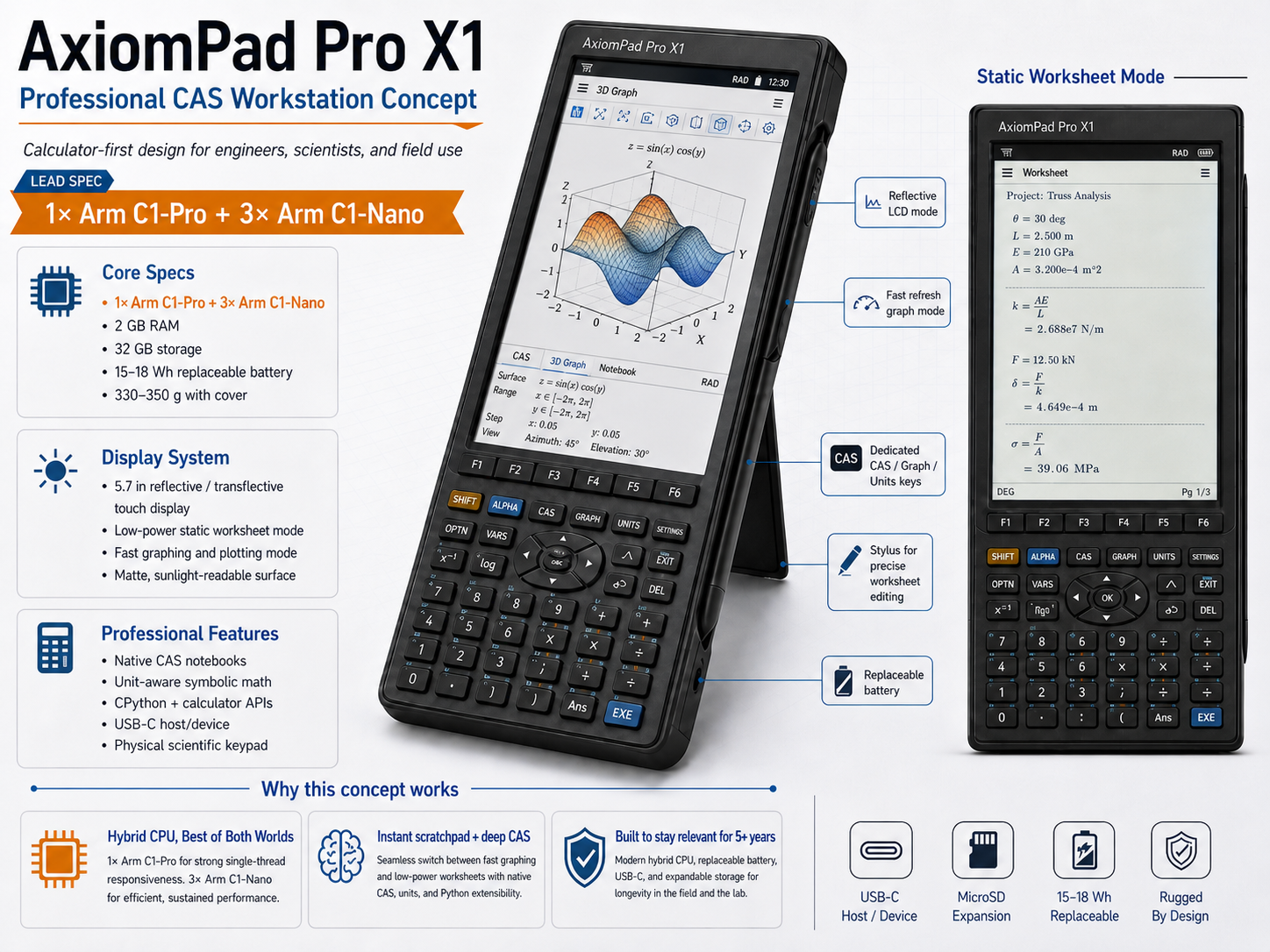
I'm thinking something that could be a major upgrade in spirit to the long-in-the-tooth (released a decade ago) Casio FX-CG500.
Could use the soon to be released ARM C-1 Nano and Pro cores in an SoC with stacked 2GB LPDDR4, USB-C charging to a large battery, high-res transflective LCD...
Mockup "AxiomPad Pro X1": https://enia.cc/out/axiompad-cas-mock.png
As an engineering student at CMU, I had an HP 15c like everyone else. A few years back when I found out they are coveted, I sold mine on ebay. I have an emulator on my phone.
I assume that calculators will continue to evolve and that my grandchildren will have a Propædeutic Enchiridion.
There should be a cheap open source calculators for schools and exams. It’s ridiculous that TI is still charging this.
do they only refer to the web app whenever they mention "online" as an adjective for the calculator? just a weird situation to be in.
given the MASSIVE margin they got selling these, i really wish they had an eink display. given the performance characteristics it would have been a great fit imho.
Also, drug wars, x wing vs tie fighter, and all sorts of other awesome games were definitely the fun thing to do with these.
"Online calculator included (four-year subscription) •($80 value)"
https://education.ti.com/en/products/calculators/graphing-ca...
Any MCU out of their portfolio should be fully capable of driving the display, reading the keyboard. And the math should be lightweight for even the smallest processors nowadays.
EDIT: oops, conflated with HP-35, from a decade earlier. 10c was programmable. HP-35 was not.
They clearly haven't met a classroom of high school kids. Then again... I didn't have access to the internet in my pocket when I was in high school so....
I still have my ti89, and my brother's 83. My kids will learn to write text based dealer simulation in ti-basic, then 68k assembly, like real men^.
^ they're boys so that cliche works
For some reason qwerty keyboard calculators are banned in tests.
Generally limitations in education on what was allowed led to more limited feature sets. Where as full feature set that could be upsold with qwerty keyboard was aimed for different users.
10yrs ago they would have been 4 to 5 figures.
Now they are what? A couple hundred?
How in the world is a TI graphing calculator still $160? These 30yr old calculator chips apparently hold their value like gold…
National exams will be wild for the kids capable of programming or vibe coding.
I hate what AI hype is doing to peoples' brains here.


Then I learned that the US Bureau of Prisons had a rule against any calculator (or device) that was "programmable". So I programmed the TI-85 so its startup screen read, "TI-85 NON-PROGRAMMABLE CALCULATOR". Problem solved.
Me in math class in 1996 - I had a TI-82 things are programmable so I have no formal education, my parents are illiterate, and taught myself to program, and I begged them to buy me one.
I spent time learning how to code on it, writing from scratch, the game Spyhunter.
I couldn't figure out how to draw with lines or pixels so I used ASCII or text.
I presented this to my teacher who told me "these aren't for games". I was crushed.
What is the matter with these people.
When I was in 7th grade I was getting 100% on all my math exams so my teacher had me test into 8th grade math (algebra). Then when I was a sophomore I was supposed to take precalc but my teacher thought I obviously didn't belong there either so she put me in her Calc AB class, which was the highest math class my school offered, but had me self-study for the Calc BC AP test during class time, taking her own time to sit down with me whenever I had questions.
A couple years later I TA'd for her precalc class and I spent most of my time in that class playing with my TI 8x (can't remember the exact model, maybe 84?) and programming very basic games on it. I showed her what I made and she was so impressed she said I should study computer science.
Guess what I did? Not that. I studied something completely different in college but now I've been a programmer for ten years and wonder why I ever doubted her at all.
Just goes to show how much impact a good teacher has on a student's life.
What could go wrong?
Don't be so quick to judge, because most people, including you would react the same way in similar contexts, for example if you were the top engineer at a company and someone started showing you up and being a hundred times better than you.
In any case refusing to nurture such a child (even in effectively passive ways like letting them quietly do something more advanced with no specific instruction) and not being reprimanded for it would reveal that the actual purpose of their position is daycare worker, which should be a bigger strike to the ego.
Now. That being said, the drive can be suppressed. But suppressing the drive doesn’t mean it doesn’t exist and that you don’t feel it. Also many people feel the drive at different levels of intensity that much is true.
Anecdotally your response to me indicates to me that you have not suppressed status seeking drives completely. The key hints are you’re referring to how you’re drawn to people who do high quality work. That is orthogonal to status seeking. Your status and identity is tied to a certain type of work you do and you take pride in. Have you worked with anyone who was so powerful that their work invalidated, crushed and basically humiliated anything you did. And let’s say this person is not malicious. He’s just so much better than you that your work and identity is inconsequential and eclipsed by his work.
If you said that you wouldn’t feel anything in the face of that then I would say that you truly do not seek status. I would also say you’re not human.
That being said a teacher holds his identity as someone who is better than children. He needs to be better than children in order to transfer his betterment (aka knowledge) to children. His role in society and identity rests on that foundation. If children are better then him and know more than him then that is inadvertently an attack on his identity. His reaction is natural and expected. It’s not that he has anything against the child, it’s self protection mechanisms to protect his identity via deluding himself. Very typical.
You see much of the same stuff with LLMs and programmers. A huge portion of HN was in denial for the longest time about the capabilities of LLMs calling these things stochastic parrots and thinking it’s impossible for the AI to take over. HN was just completely wrong about that and they were also wrong about driverless cars. The reason why they were so wrong is not because they’re making a logical and rational prediction… no they are choosing the prediction that most aligns with protecting their identity and skill set as programmers which is in the process of being replaced by agentic ai.
To color that a little, I've literally told the last 4 managers I've had very explicitly that I'm not at all interested in career advancement. When I was asked to lead my current team, I said "I've done it in the past and can if you want, but check with A and B first to see if they want to". I literally do not care about it. Work is a means to provide, and it does well enough that I don't need to chase it anymore. Actually the marginal pay for the increased responsibility kind of doesn't make it worth it, but like I said I'll do it if they need that. And so my focus is generally thinking about "how do I get one of my team members in a place where they can replace me?"
If we're talking about who's more human, I'd put forward that caring about who's best seems less humanizing than seeking to spend time with people you care about, remembering how lucky you are to have that time, and ignoring outside noise.
Especially when it comes to teaching, if your identity is "better than child" instead of "person who helps children reach their potential" I'm not sure what to say. Sounds like a narcissist.
On LLMs, I found them to be useless but interesting right up until December, at which point I started a hard push for my team to adopt it (and get excited about it). I'm very explicit that my mental framing with them is "how do I get it to do my job". I'm well aware that "programmer" per se is not going to be a job in the future. That much seemed obvious as far back as the original chatgpt release. That's fine, and just means we have to ask ourselves what else needs doing. If we ever get to the point where the answer is "nothing" then I guess we're all doing pretty well.
Read carefully the part about science. Status seeking is inherit in biology... it's tied to serotonin levels in your blood. When you say you don't seek status it is not only false, it is unscientific. You're a liar or delusional. End of story. I can literally cite science around this.
https://www.nature.com/articles/s41386-022-01378-2
https://pubmed.ncbi.nlm.nih.gov/11275287/
https://www.pnas.org/doi/10.1073/pnas.1606800113
This tracks not only in humans, but across multiple species including the lobster. Status seeking is in built into biology and society. Saying you don't status seek is like saying you never felt the emotion of sadness or happiness. At your job, in society, the social hierarchies are everywhere and we are ALL wired to recognize and respond to these things and to SEEK it.
Additionally there is extremely high correlation with women and status. Men with the highest status tend to get the most women. And women are attracted to the men with the highest status. It's directly tied to sexual selection and evolution. Like... this isn't even just a measurable thing via serotonin... it's tied to the theory of evolution and anthropological origins of humans. You literally have no argument other than a pathetic attempt to counter science with anecdotal bullshit.
Saying you don't seek status is in itself status seeking. You're claiming to be holier than thou but it's all just bullshit status signaling because it flies in the face of scientific reality. I think you're more of a person who is unable to obtain status in the human social hierarchy... you're probably among the lowest of society so you might've just given up and called yourself a person who never felt the emotion to status seek. Understandable... but again not realistic.
Also when I say you're pathetically on the bottom of the barrel in terms of status. You shouldn't be offended... because you don't seek status... it's not intrinsic to your character.. You should feel nothing when I call you an utter social outcast with no status whatsoever.
>To color that a little, I've literally told the last 4 managers I've had very explicitly that I'm not at all interested in career advancement. When I was asked to lead my current team, I said "I've done it in the past and can if you want, but check with A and B first to see if they want to". I literally do not care about it.
Bro this is another form of status signaling. "Everyone wants me to be their manager but I don't care for it." lol. It might be true but then again it very well might not be since your statement is a bit braggy here. If you could share with me something people and society will find pathetic and shameful about you... that's more solid proof that you don't care about status. Something like, "Everyone hates me, I've tried to be manager all my life but nobody likes me." That's a more true signal of zero status seeking. But I don't see this in you at all.
To put it in perspective, I think I believe you don't actually want to be manager... but that has nothing to do with not caring for status. It's more likely you're balancing "status" with the extra responsibilities that come with higher status. You can't handle the price that needs to be paid to reach that level so you "settle". Again, very common. You maintain a baseline level of status high enough to keep your wife around (she will leave if your status goes low enough as your status is tied to your ability to raise your family) but it doesn't demand to much out of you. If status was given to you without cost... you would take it without hesitation because... again... you seek status, like all humans do.
>Especially when it comes to teaching, if your identity is "better than child" instead of "person who helps children reach their potential" I'm not sure what to say. Sounds like a narcissist.
No. You're just someone who can't face reality. You have to talk about everything in idealist terms. If a teacher thinks all children are smarter, more educated or better than him, what identity does he have left? How is he even qualified to teach children? A teacher or any human does not think of his job as some selfless charity to society where he is at the utter whim of sacrificing himself for the class room. He has identity and gains status from the role as a "teacher" and that is a huge part of it. It's the same with being a doctor... if you think people become doctors solely just to save people and that it has nothing to do with status... you're out of touch with basic reality.
You not only fail to empathize from the teachers perspective but you succeeded in twisting your response into a direct attack on me. Manipulative. But pointless. This is just an internet forum... winning the crowd doesn't mean shit. This is one of the few opportunities you have to say things that are True and real with no affect on your status.
Anyway what I present is CLEARLY not a narcissistic concept. I am clearly not a narcissist and neither are you. It is a basic concept of basic intelligence. Something you're lacking.
>If we're talking about who's more human, I'd put forward that caring about who's best seems less humanizing than seeking to spend time with people you care about, remembering how lucky you are to have that time, and ignoring outside noise.
When I referred to humans I was more trying to illustrate how your claims don't make sense. Humans seek status period. End of story. If you don't seek status, you're not a human... you're an alien... you clearly aren't an alien... so you're clearly wrong. That was the point.
I'm talking from a hard scientific perspective. You're well outside of that right now and you're only thinking from the perspective of your family. But status seeking is still there, but it's more passed to the status of your children which is still inline with natural selection and biology.
You care for the status of your children, do you not? If your children grew up poor and homeless but extremely happy with their life style would you be content? Or do you care about the status of your children and not want them to grow up ending up in the lowest possible strata of status in human society?
But you’re talking to a person who can point at their actual life and say: I have been in that exact situation and I can confirm that I did not behave that way.
That’s a new observation, and afai understand Bayesian statistics, this is the moment where we must update our priors: how likely is someone who has observed themselves in the past not to behave that way, to behave that way?
Your argument is now incomplete.
Maybe someone with real understanding of Bayesian statistics can frame this better, or tell me why I’m wrong XD
> Your argument is now incomplete
If my argument is scientific and it’s incomplete then are all scientific arguments incomplete? If science is our best way of determining fact from fiction in reality then based off of the aforementioned logic isn’t the best possible way for humans to determine truth incomplete?
Also in Your attempt to prove me wrong have you thought about how MORE incomplete his argument was?
> I've worked with people who were super productive with high quality work, and my reaction was to... gravitate toward working more with them.
Neither type of statement is perfectly trustable (nothing is) but IME there is a categorical difference. Your paper (and first comment, “don’t be so quick to judge”, which imo was ironically prescient) are about the former type.
Of course if you disagree with me on this fundamental distinction then we have found our contention :) which would be a nice end to this debate. Don’t you think?
If he’s drawn to people who do productive work that’s fine. I turned around and asked him for instances where someone’s work humiliated him or completely eclipsed any utility his work offers. Imagine he worked 10 years to invent the slide rule and some genius invents the electronic calculator in one day right after he showed his invention to the world. That’s devastating status damaging stuff. That’s the type of example I asked him for. Not “oh I’m drawn to work with productive people” lol. That kind of comment he made leaves room for him to imply he’s “more productive” than the people he wants to work with. He’s a poser but then that’s not abnormal… tons of people pose and are fake as hell.
Literally look at what he writes. He’s just incapable of admitting any trivial fault. He’s fucking controlled by status above a normal extent for sure. We don’t even have to get into the pedantics of science for this just use your common sense brain.
I'm simply happy with that. I can't offer a situation where I've been humiliated because it hasn't happened. I've never seen anyone get humiliated at work. Most work is honestly pretty boring and straightforward. I'm not Leonardo da Vinci here hoping I don't get scooped.
I mean I suppose a week or two ago another engineer proposed some simplification to a problem that I'd prototyped a solution for that basically eliminated 90% of the work I was doing (basically smuggling some information into SNI so that I wouldn't have to build a bunch of code to track it), so I guess that happened? But I just said "oh, yeah, you're right. I can delete like 90% of my MR. Nice."
But then I do that to myself all the time too. I have some first approach, and then like a week later notice some simplification I missed. That's normal? I just join stand-up that day and day "good news I realized this problem is way simpler so I can delete half the work I did."
In fact that's why I like working with smart people. They can help see things you missed when you accidentally get stuck in a rabbit hole. I'm not going to be mad at someone for making my life easier. And as I've said, I go to work to support my family, not to fulfill some existential need. Whatever makes work simpler is good in my book. That's also why I've enjoyed adopting LLMs this year: they make it so I don't have to spend as much mental energy on things that are fundamentally not that interesting to me
Then how do you even know what the emotion of "humiliation" even feels like if you never been humiliated before? Perhaps you felt such emotions in childhood but as an adult you've never been humiliated ever? Or perhaps you're going to tell a story of slight trivial humiliation when you accidentally used the wrong gender pronoun and that's the totality of your understanding of humiliation?
Your story is too perfect. It's fake-ish and as you tell more of it you're starting to see holes in it like your claim that you've never been humiliated before.
>I mean I suppose a week or two ago another engineer proposed some simplification to a problem that I'd prototyped a solution for that basically eliminated 90% of the work I was doing (basically smuggling some information into SNI so that I wouldn't have to build a bunch of code to track it), so I guess that happened? But I just said "oh, yeah, you're right. I can delete like 90% of my MR. Nice."
this is your least tame example yet, but it's still not humiliation. I in actually can't believe you felt perfectly fine and serene when the other engineer schooled your approach. I think if you were more honest with the story you would've admitted to slight to mild feelings of embarrassment and you just ended up humble about it as most humans would.
At this point you're just trying to show off your claimed non-status seeking personality... but your signaling has gone to the point where it's just a little too perfect. You should probably reply and add more realism to that story man, go ahead if you want:
Your YouTube channel is status seeking. Currently not doing well at all.
Don't know what to tell you. I'm not the first person to not be interested in "the rat race" (hence the pejorative term for it existing). People like Emerson have probably made the case better than I can. I'm not interested in getting the most women. Actually that sounds gross to me. I instead found the best woman, and fortunately she's also not big on status seeking, and agrees she'd rather have more time with me than me making more money or having a bigger title. My work is a side plot in our lives; my primary title is "Dad".
Unclear how my criticism of a theoretical teacher (or more generally adult) who competes with the children they're supposed to be supporting is a direct attack on you? Self-report? If you're insecure about a literal child's abilities, the solution is to grow your own and show the child that everyone can always be improving, and there are always new things to learn. Or just be happy for their good fortune. Hamstringing them to make up for one's own hangups is clearly narcissist behavior.
It's also not just management. I don't want to climb the IC ladder either. It means more work, more stress, more responsibility, etc. for a relatively small amount of more money. I already make enough money, and I work for money, not status. That money is to pay for things we need like a house. Then once we have what we need, I plan to retire early and spend more time with my family. Maybe find some volunteer work that we could do together. That's it. Work is a side chapter, not my life.
My wife is also on board with this. She was unsure what it would be like when I transitioned to full remote, but then I did and she realized she likes being around me all the time, and wants me to quit once we've paid for the things we need.
I don't think they would be happy homeless so it's somewhat of a silly question. I try to set them up for success and what I think will help them be happy, but that of course includes showing them how to stay grounded. I do hope they'll have modest wants so that it's easy for them to see life as the gift it is.
Your arguments aren't even science. Barely but sure? What about your own anecdotal statements? That's even less reliable. If the science is all we got, then it's the best we got.
>Don't know what to tell you. I'm not the first person to not be interested in "the rat race" (hence the pejorative term for it existing). People like Emerson have probably made the case better than I can. I'm not interested in getting the most women. Actually that sounds gross to me. I instead found the best woman, and fortunately she's also not big on status seeking, and agrees she'd rather have more time with me than me making more money or having a bigger title. My work is a side plot in our lives; my primary title is "Dad".
We can frame it in terms of the science. You do seek status, but like many you have the inability to pay the cost of reaching higher social status levels, so like many settle for some sort of middle ground. It's extremely common. When you have kids, a huge portion of your "status seeking" shifts to the status of your kids. You work to promote their status in life and you derive a lot of pride from that. In the end it's still status seeking. Whether you seek it for yourself or your genetic future, evolution built you that way.
>Unclear how my criticism of a theoretical teacher (or more generally adult) who competes with the children they're supposed to be supporting is a direct attack on you? Self-report? If you're insecure about a literal child's abilities, the solution is to grow your own and show the child that everyone can always be improving. Or just be happy for their good fortune. Hamstringing them to make up for one's own hangups is clearly narcissist behavior.
It's very clear. You said I sound like a narcissist. That is clearly an attack. It's like if I said your statement sounds like it was said by an idiot. That's also an attack. But it's sort of indirect attacks that skirt around the rules. I didn't say you were an "idiot"... I said your "statement" sounds like it was said by an "idiot". I just cut through the bullshit and went for the intent of the statement.
>If you're insecure about a literal child's abilities, the solution is to grow your own and show the child that everyone can always be improving.
No one is insecure about a child's abilities. They're insecure about their OWN ability to help children. That is the source of the person saying that calculators are "not for games". The person saying that needs an excuse for himself to qualify as a teacher. It happens so fast the person saying that doesn't even realize why.
>It's also not just management. I don't want to climb the IC ladder either. It means more work, more stress, more responsibility, etc. for a relatively small amount of more money.
I've already pointed this out. You're not willing to pay the cost so you settle.
>My wife is also on board with this. She was unsure what it would be like when I transitioned to full remote, but then I did and she realized she likes being around me all the time, and wants me to quit once we've paid for the things we need.
She settled too. Most people in life settle. Top alpha status is hard to get and their are huge costs in getting that status. Everybody wants it, but they just don't want to pay the price.
>I don't think they would be happy homeless so it's somewhat of a silly question. I try to set them up for success and what I think will help them be happy, but that of course includes showing them how to stay grounded. I do hope they'll have modest wants so that it's easy for them to see life as the gift it is.
So they seek status. Because they won't be happy homeless as being homeless is low status.
>I try to set them up for success and what I think will help them be happy
So you think success (aka status seeking) is intrinsically tied to your children's happiness. Stop signalling bro. You're own language and statements reveal yourself.
>I do hope they'll have modest wants so that it's easy for them to see life as the gift it is.
Again this is the evolutionary strategy of "settling". Your passing your own status seeking strategy to your children. And your strategy is based off of "cost" it is not based off of a lack of desire for status. Again, you think optimal cost/benefit ratio is to be a SWE or something. Some people target something lower then that like janitorial engineering. But if status fell on each of your laps for free, you'd take it.
Also it's not just cost/benefit. Status also measures capability. You and your children may be incapable of getting the statuses you want so you settle. When a person is unable to talk about their own weaknesses and lack of ability to get the status they want, then I know they intrinsically seek status. That's why your anecdotal statement of how you turned down a management opportunity even though everyone wanted you to be manager is kind of off. You were humble bragging and bragging is a form of status projecting.
Again, if you truly don't seek status... tell me about something shameful and pathetic about you that if people in general knew about it would lower your status.... can you do that? If not, then that's my point. You, everyone, and that teacher seeks status and the way they talk and what truths they admit to themselves is a result of THAT status seeking. To characterize that teacher as some kind of narcissist or evil person is a complete lack of empathy and misunderstanding of human nature.
Keep in mind, this is the internet, anything you say here doesn't really affect your status in real life. So you're not doing anything in reality to affect your status. But it's still tangible evidence because I believe that status seeking in biology is so strong it will affect your ability to even say something extremely shameful and pathetic on an anonymous forum. Your genetics and behavior were evolved for a time when humans didn't have internet so it doesn't account for this loop hole where you can write and say things publicly that don't affect your status... hence why I'm sure you're gonna maintain your idealistic frame here.
If you accept that premise, then you can't frame it in terms of science. You can frame it instead in terms of culture and philosophy, and just say that status obsession is bad. Especially, again, if it turns into literally competing with or feeling threatened by children.
And really, not everything is about status. In fact, if you want something status lowering I guess, we're kind of Billy No-mates, so I don't even have people to compare status with. I've got no Jones' to keep up with! And that's fine.
Again, I've "settled" precisely because I have exactly what I want. It's not the "costs" so much as it is the absence of value. You could argue that I wouldn't pay $100 for a turd because the cost is too high, but the real point is I don't want the turd. You'd have to pay me to take the turd. Like you'd have to pay me to take the higher status job, except they can't pay me enough, and if they did, it would be because I'd be able to save enough to quit shortly thereafter. So really there's just no sustainable world where I keep the higher status position. Because I really, truly, don't want it. It can only distract from what's important to me, and fill my head with things that are not.
Being homeless is an unhappy affair because it's some combination of cold, rainy, snowy, hot, sunny, and stinky, not because it's low status. And because you have nowhere to store e.g. food or clothes, so your situation is precarious. And nowhere to cook, so difficult to eat healthy meals. I highly doubt most homeless people have social status as a top concern.
I'm not sure what I could say that's "shameful" because I'm generally a pretty happy person. In techie circles, I suppose one thing is that my kids are all girls, and I'm going to encourage them to be stay-at-home moms instead of chasing careerism, try to put them into social circles where promiscuity is heavily frowned upon and the primary reason to go to uni is to find a husband (an "Mrs degree"), etc. Very much against the zeitgeist in my work world (and on this site), but I think it's the best way for them to find happiness. So we moved to the South to stay away from West Coast values.
If you think my statements are garbage think about your own statements. You call me out for presenting valid scientific papers by denigrating the whole field of behavioral science which you then refute by pulling out random anecdotes which aren’t even backed by anything.
> If you accept that premise, then you can't frame it in terms of science
I don’t accept that premise. All science has the possibility of being wrong. It is often wrong. But it is the best we have and it has resulted in remarkable things such as going to the moon.
Anecdotes are weaker than science. If behavioral science is trash to you then the your anecdotes are raw shit.
> Again, I've "settled" precisely because I have exactly what I want. It's not the "costs" so much as it is the absence of value.
The foundation of economic theory is based on unlimited human wants and desires. We baked this assumption into theory because it’s so ingrained in human behavior that it’s the foundation of the financial world.
How about I give you an extra ten million dollars with no strings attached? If you say you don’t need it then I see it as more likely you’re just virtue signaling and lying. Bro be real.
> Being homeless is an unhappy affair because it's some combination of cold, rainy, snowy, hot, sunny, and stinky, not because it's low status. And because you have nowhere to store e.g. food or clothes, so your situation is precarious. And nowhere to cook, so difficult to eat healthy meals. I highly doubt most homeless people have social status as a top concern.
Oh let me change that to being homeless in sunny CA with free shelter and food. Most homeless people in SF have completely free access to food anyway. Or how about if your kids worked as a poor waitresses for the rest of their lives but were happy? Obviously that’s what I mean right? No point in getting pedantic about specifics when I’m talking about status.
> I suppose one thing is that my kids are all girls, and I'm going to encourage them to be stay-at-home moms instead of chasing careerism,
That’s a pretty tame one. Not really going to lower your status. You got any sexual kinks? Perverted stuff you like to do in bed that you’d never admit? Do you have any slight interest in men that you’d never admit? Anybody in your family you hate and you think should die?
That’s the level of things I’m looking for. If you truly didn’t care about status you’d be able to admit it.
But if your your perfect ideally on every level I find that harder to believe unfortunately.
We can end the argument here. You won’t be able to prove your stance (event though I’m not even asking you for scientific data) and the science I presented is the highest level of evidence anyone on earth can offer in an argument anyway. It’s not going anywhere so I’m happy to end the argument here but if you want to continue I’m still down.
As a side note, status is even more important to women than men. Your own daughters will date based off of status and they will by nature generally hold status of themselves in higher regard than you. Men are less concerned with status (though still concerned) and are not in actuality concerned with status when selecting a mate as opposed to women where status is part of the main criteria. If you want to empathize with your daughters and women in general than understanding status is part of reality. But of course like you, ironically, being concerned about status, is signal for low status so often people are in denial or they lie about it.
Physics is founded on spherical cows. Doesn't mean it's true. But sure I'll take extra money. I already said I'm working to accumulate more of that. So I can quit. But I wouldn't take $10M if it e.g. meant I had to be CEO of a F500 or something for 10 years. You literally could not pay me to have to do that job for a decade. And if you paid me $5M/year or something, I'd quit after 3 months and be happy.
I wouldn't want them to be homeless in San Francisco either because it's dirty and unsafe, and again I don't think it's a road to happiness. If they really enjoyed waitressing, whatever, but the thing is I think if you're truly happy with life, you'll probably want to form a family and share that happiness. And then something like waitressing is likely a distraction from that, just like software is for me.
I'm pretty sure "actually I don't want my girls to go into STEM and want them to be homemakers" is way more status damaging in the software world (when my first was born a colleague literally asked if I was going to teach her to be a programmer. Uhh, sure) than sexual proclivities of all things lol. But alas, I can't even say I'm into butt stuff.
I don't think I'd characterize being gay as an "imperfection" or something to be ashamed of?
But wanting someone (especially family?) to die is uh pretty hardcore. So no I can't say I've got anything like that for you. I honestly just never need to interact with people I don't like. It's pretty easy to choose your own social circle once you're an adult.
I'm not at all claiming I'm perfect (e.g. I could probably lose ~10 lbs of fat. I could always stand to have more muscle), and I realize it's in vogue to have mental health issues, but there's a reason being normal is... normal. I have to imagine most people don't really have anything to be ashamed of, and most adults grow out of whatever insecurities they may have once had.
The teacher (Mr. R) was a math teacher. He lived in his bubble and my guess is he had no children, or no boys. I had excessive mental energy without a proper outlet or direction. I managed to change every Apple 'error' sound to an annoying rendition of his name (Mr.R) would ring out on every computer until it was corrected.
While I may have been smarter and more talented than him - I was not above him in any respect during school. He had more experience and grounding in life - of which he offered me zero.
In hindsight I wish he did the following, which is how I behave today with others; ask hard questions and give them direction to meet their goals.
I do not blame my parents for their inability to see I was in the top 2% of intelligence. I cannot blame the teacher really either. Each of us have potential to be wonderful at something. We need to learn what it is and have the ability to use our talent. I finally learned my talent despite my desire for status. I ignored status, adopted the idea that I need to to develop my talent, and it has now paid off dividends.
Being happy is actually very simple, just not easy. Do the things that make you happy.
Bro. Is this not status seeking? This statement is arrogant. But it could be true.
>I ignored status, adopted the idea that I need to to develop my talent, and it has now paid off dividends.
What sort of dividends? I bet you it's related to higher status.
>Being happy is actually very simple, just not easy. Do the things that make you happy.
In a way you're right. It's paradoxical because of the human drive for status. Gaining high status involves a lot of stress and activities that don't inherently make someone happy. It's a competitive world for a high status position.
Not competing is low stress and involves many behaviors that make you happy. But ironically while one part of you is happy, another part of you is unhappy because you are aware of your low status.
So people usually choose a middle ground. Everyone basically seeks status to some form or degree, it is fundamentally impossible to have this status seeking be absent. The person I'm talking with more likely meant that he... like many people ... compromised on status.
Isn't that just a kafkatrap?
Consider the following exchange where a sane man finds himself in a psychiatric ward:
John: I'm telling you, I'm sane. I don't have any delusions of grandeur and I don't think that I'm Jesus.
Evaluator: I see, your subconscious delusion and erroneous insistence upon sanity are more pervasive than I thought. Your repeated attempts to assert that you're not Jesus is clearly a defense mechanism. I'm afraid I cannot recommend your release.
Something went wrong here.
Or to rephrase: suppose that a person existed who was not status driven. Would you be able to detect such a person if they existed?
The thing many people do not understand is how ingrained status seeking is in not just human biology… but biology altogether. Even the lobster has serotonin and is status seeking. It is also in built into our society. Practically every facet of every culture across time has status seeking imprinted into it. Among academia and people who study the biology and behavior it’s unequivocal that people are status seeking.
Basically to help you understand where I’m coming from it’s like this guy is claiming he’s never felt jealous before. “I’ve never cared that someone has more than me or covetted what another man has. It’s just illogical! I’m baffled that other humans act so illogically”.
It’s like that. It’s fake and it’s posing a bit. A lot of HNers like to position themselves as super intelligent people who are incapable of being status seeking or jealous or even feeling scared because it’s “illogical”
https://codeberg.org/luxferre/mu808
This could be adapted https://codeberg.org/luxferre/scoundrel-ports
More info at https://luxferre.top
Inform6 it's a 'small' OOP language where with the English library the syntax it's dumber than VB6, Lua or anything else. Basically the objects and logic describe themselves as a dumbed down config file. You create a meta-object for rooms and light, and then copy and paste to create rooms, containers and tools based on atributes (again as if it were a simple config file).
Inform6 example:
https://jxself.org/git/?p=cloak-of-darkness.git;a=blob_plain...
Inform6 compiler:
https://jxself.org/git/inform.git
(cc -o inform src/* )
Inform6 lib
https://jxself.org/git/informlib.git
To compile Cloak...
Lib should be the English library, you can get it with or copy informlib to lib/To play the game:
Or LectRote under Mac... or WinFrotz under Windows, it will work the same.With Inform7 you just write clauses in English, the interpreter will write IF6 code for you and then call the inform6 compiler to create a Z5-8 game ready to run.
https://en.wikipedia.org/wiki/Inform#Inform_7
As you can see, no AI needed, no LLM's, no huge GB sized software, just a Pentium MMX could be enough for i7, a 8-16 bit machine for Puny Inform games (kinda like Inform6 'lite'), a 16 bit machine for z3-z5 games and maybe a 'high end' 16 bit computer for Z8 games. A 386 PC would be enough to run 'complex' text adventures. And consistent enough unlike LLM's where the objects' enviroment is lost everytime.
This behavior often came out as rebellious or prodigy behavior in grade school but I don't think it's any of that. I think it was just a matter of giving a curious kid space to play and learn and grow. kids like me often don't thrive in rigid environments not because we don't like rules or think they shouldn't apply to us but because our brains just don't work completely linearly.
I'd wager that most kids actually learn better like this but it's not super efficient to cater to 30 different curious kids wanting to learn 30 different things.
Since I wasn't able to use computers or the Internet for that time, I did/read/learned a lot of things I wouldn't have otherwise learned. Learned how to make hooch (prison wine), how the law works and how to maneuver the court system (useful for both civil and criminal cases), got more fluent in French by speaking with some native French speakers from Benin, learned how to work out & lift weights (which I still do), and learned the value of freedom.
Are you still coding these days? Does AI instill any new sense of awe and wonder or a new found passion for coding/computers? Hope you are in a better place now. Cheers.
Legend.
In high school my stats teacher told us we had to get a proper calculator. She didn’t set any upper limit so i went down the calculators rabbit hole… and got an used ti-86 from 1999 off ebay for 35 euros (this was in 2007 or so).
I programmed software to solve exercises in ti-basic and spent every lesson doing essentially software testing: basically whenever a classmate was called to the blackboard to solve an exercise I’d input the exercise data and verified I got the right results.
I got 9.5 out of 10 to the immediate next test. The teacher took off half a point because i miscopied a number (0.3 rather than 0.03, i still remember that after almost 20 years). It would have otherwise been a perfect test.
Fun times.
I still have that calculator, i turn it on every now and then.
I remember naming that calculator “Annarita”, like a girl I used to like and that (of course, lol) barely knew I existed at all.
I had a 3D calculus class so I wrote a program in it to plot a 3D isometric mesh of a surface using the 2D rendering library. It was slow but got the job done. I used it to help pass a test or two.
I also experimented with drawing random surfaces and objects like a tire. They looked pretty cool for a calculator screen.
The math lab at the college had a cable which you could use to take data off or put it on so you could in theory have exchanged programs with others but this was before the internet so I didn't.
I still have mine and enjoy the sliding the cover off - a trip down memory lane.
Later I rewrote the program in QBasic on a PC for fun and it was lightning fast!
The TI-92 had recently come out, and it had a QWERTY keyboard and could solve symbolic calculus problems like "find the derivative of 2x^3". This was a problem for the AP exam, since you could just type in the problem and get the answer. They fixed this by banning calculators with QWERTY keyboards. That's just about exactly when the TI-89 came out, which also did symbolic calculus but did not have a QWERTY keyboard, and so it was totally allowed on the exam. Boom, 5/5 exam score for Jorji.
Spent some time on ticalc.org too, making some not-great stuff to get me thru those years
https://www.ticalc.org/cgi-bin/acct-view.cgi?userid=34493
TI-81 (1990)
TI-85 (1992)
TI-82 (1993)
TI-80 (1995)
TI-92 (1995)
TI-83 (1996)
TI-86 (1996)
TI-73 (1998)
TI-83 Plus (1999)
TI-89 (1998)
TI-92 Plus (1998)
TI-83 Plus Silver Edition (2001)
TI-84 Plus (2004)
TI-84 Plus Silver Edition (2004)
All of them are basically a multi-generational scam perpetrated against the hapless parents of American high school students who were told that they needed to buy overpriced anachronistic calculators for their kids to succeed in school. In my opinion the calculators have overall caused more pedagogical harm than benefit; the students would be better served by some combination of (a) problems that can be solved without the tedious but trivial numerical calculations these calculators support, or (b) are solved using a real programming language. If someone really wants to assign simple numerical problems, give the kids slide rules.
Calculators of this type used to make sense for an engineer doing work in the field somewhere, but make no sense in the context of a classroom.
There is an interesting side effect from having always used TI calculators. They use a dot as the decimal separator, not a comma like we do here. There is usually some option to switch, but the hardware button obviously stays the same, so I’ve always been taught to just make that switch in my head, and it has become the natural thing for me to do. I see 1,000.50 on a screen I write down 1.000,50. When I use software that uses a comma as the decimal separator, I get annoyed and it takes some mental effort to enter the right values.
… that continues no matter what. I gave my kid my 89 from the late 90s—I was happy to avoid the TI student tax. Then a year or two back, the college board banned the 89 from certain tests/classes and so I had to cough up for an 84. Even if you take care of your stuff, treat it well to pass on to your kids, the Man finds a way to extract their cut.
My favorite was always the TI-85/86 line. I loved those F1-F5 buttons right beneath the screen, which made the interface overall better to navigate. The first programming I ever did was on one of those (either the 85 or 82, can't exactly remember at this point which I owned first). And, the only thing of note I ever had stolen from me was a TI-82, taken out of my unattended backpack by another student during gym class :( (And I had even carved my name into the back of it with a knife, so it would've been identifiable.)
In common use, they're intended as mathematical learning aids, a function for which very specific sets of functionality (and no more) are required.
F.ex. basic matrix ops but no auto-solvers
Similar to how you wouldn't give a kid learning how to construct an argumentative essay access to a full LLM if the goal is learning how to perform the task.
I just want one device that does everything so my new learning can build on my old.
As I’ve mentioned elsewhere here, I love the TI-85 I used through college. I’m no partisan. However, I think that for anything outside a school context, that means skipping any device marketed as “ok to use on tests” and buying an HP. I scarcely need the cool stuff of the HP50g or DM42n I picked up along the way, but if I ever do, I know it’s already in there and waiting for me to discover it.
So one could attest that a calculator was currently running the "Grade 6-US" feature set standard.
But I imagine in the 1990s doing so at consumer device scale was dicier. I.e. where would upgrades be applied?
TI83 (1996) was a successor to the TI82 (1993) which was a refresh/update of the TI81 (1990).
TI85 (1992) was the second model they made, originally intended as a higher end version of the TI81.
Similar reasoning for the rest of their line up. Different models had different features, and then those models would get incremental updates/refreshes over the years.
I wasn't part of the team or anything, so if anyone has any insight to why exactly they called it that in the first place, I'd be interested to know, but generally speaking the answer is: When they released the first one in 1990, they didn't name it under the presumption that this family of devices would be a staple educational/academic electronics device for the next 3 decades with dozen(s?) of different iterations/generations over the years.
Joerg Warner has been collecting them exhaustively, and peering inside for date codes and such.
I programmed quite a cheat sheet worth of formulae etc into my calc. Right before the test, I dropped it onto the floor. The battery cover popped off and the AA batteries popped out.
These were TI-81s (IIRC) so no battery backup -- it was a full memory wipe every time you changed batteries. Sooooooooooooo... goodbye cheat sheet!
However, I aced that test anyway, legitimately. Creating the cheat sheet actually helped me to learn the material. There's a lesson or two in there somewhere...